

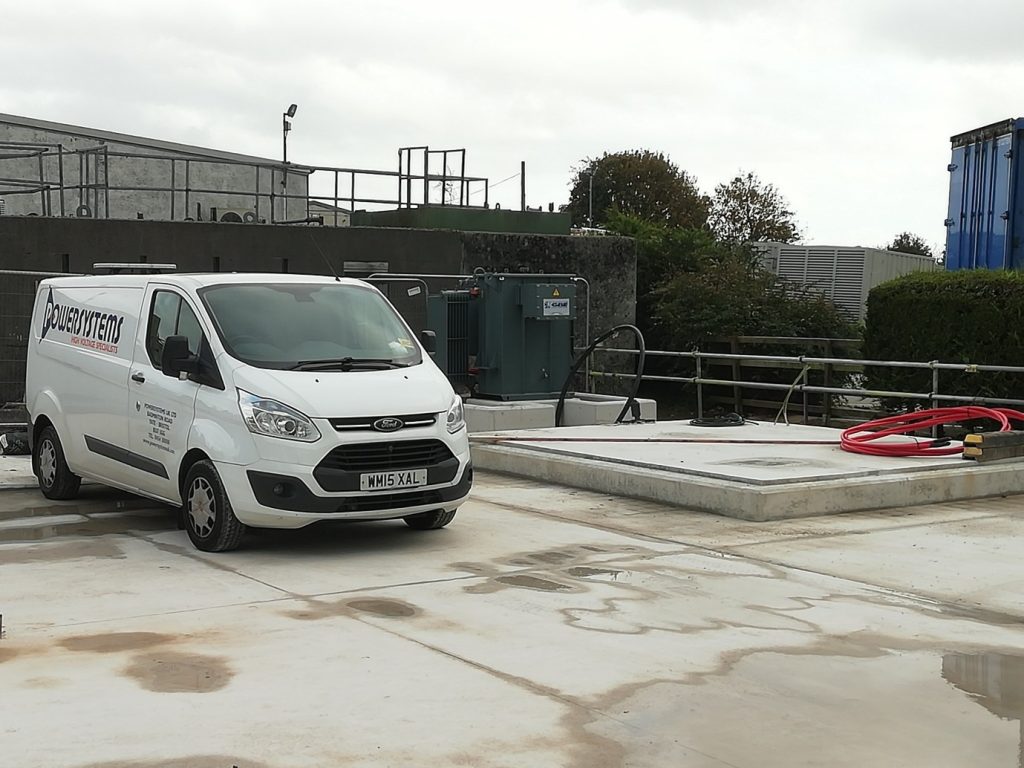
High‑voltage design, installation and commissioning for on‑site generation and energy efficiency
Project Snapshot
| Project Detail | Information |
| Client | BasePower |
| Location | The Cornwall Bakery, Callington, PL17 7XG |
| Project Value | £88,980 |
| Project Duration | Stage 1 (2017) • Stage 2 (Aug 2019–Jan 2020) |
| Services | Electrical Infrastructure, Combined Heat & Power (CHP) Grid Connection, HV Installation, Testing & Commissioning |
| Market Sector | Cogeneration / Industrial Manufacturing |
| Installed Capacity | 2.7 MW CHP |
| Connection Voltage | 11 kV |
| Powersystems Role | HV contractor for full electrical infrastructure design, installation and commissioning |
| Powersystems Fact | Since 2000, Powersystems has delivered high‑voltage connections for over 22 CHP generator projects across the UK, supporting industrial clients with cost‑saving on‑site generation. |
Cornwall Bakery 2.7 MW CHP Case Study
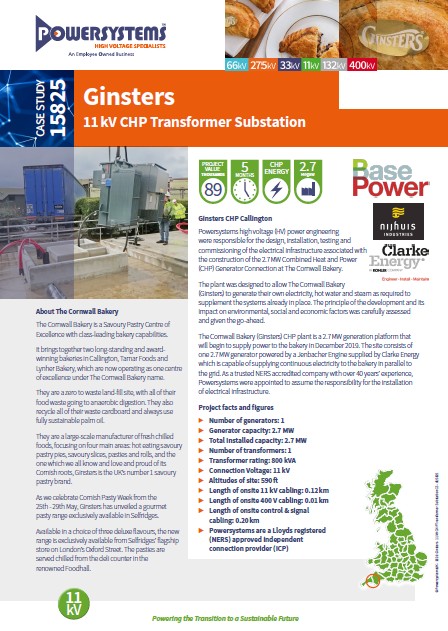
Download the full Cornwall Bakery CHP Case Study — written for engineers, developers and technical stakeholders seeking detailed insight into the delivery of this 2.7 MW on‑site generation scheme. This summary outlines the 11 kV grid connection, transformer and RMU installation, protection design, G99 compliance testing and full electrical infrastructure delivered by Powersystems for the CHP integration. It provides deeper technical detail on cable route design, HV earthing, import/export control, voltage‑constraint signalling and the interface with WP and explains how Powersystems supported BasePower and Clarke Energy in commissioning a highly efficient CHP system that improves energy resilience, reduces carbon emissions and delivers significant long‑term cost savings for one of the UK’s leading food manufacturers.
Client & Site Background
The Cornwall Bakery — home of the nationally loved Ginsters brand — is a major savoury pastry manufacturer and a recognised Centre of Excellence for chilled foods.
Operating as a zero‑waste‑to‑landfill site, the facility embraces sustainable practices including anaerobic digestion of food waste, full cardboard recycling, and responsible sourcing.
To support rising energy demands and reduce environmental impact, the bakery partnered with BasePower to deliver an efficient on‑site Combined Heat and Power (CHP) generation facility.
The Challenge
Manufacturers with high thermal and electrical loads face rising energy prices, operational risks and increasing sustainability requirements. The Cornwall Bakery required:
- A reliable on‑site 2.7 MW CHP generator to reduce grid dependency
- An 11 kV connection integrated into an existing and ageing HV network
- A compliant G99 generation interface with Western Power Distribution (now NGED)
- New electrical infrastructure designed around an operating food‑production facility
- A system capable of exporting energy within DNO limits
- Safe installation within constrained working areas and tight programme deadlines
Powersystems were appointed to design, install and commission the full HV infrastructure to bring the CHP system online.
Our Engineering Solution
Powersystems delivered the complete high‑voltage connection solution, including:
- 800 kVA 11/0.415 kV transformer installation and earthing system
- Schneider RN2c‑T1 Ring Main Unit (RMU) installation
- 11 kV cabling between the intake substation, RMU and ABB G99 circuit breaker
- Design and installation of a Power Measurement Panel for import/export control
- 400 V and LV auxiliary supplies into Clarke Energy’s control panel
- Control, signal and communication cabling for generator protection
- Voltage‑constraint signal integration with WPD
- Full G99 testing, energisation, commissioning and handover
This allowed the bakery to generate electricity, hot water and steam from a single, highly efficient CHP system.
Project Process
- HV design, cable sizing and protection studies
- Preparation of transformer bund, plinth and cable ducting
- Delivery and installation of transformer, RMU and G99 breaker
- 11 kV and LV cabling works, containment and terminations
- Earthing integration and bonding
- Protection and G99 relay commissioning
- HV testing, pre‑energisation checks and SAP‑controlled energisation
- Initial generation achieved December 2019
- Final handover January 2020
Project Facts & Figures
- Generators: 1 × 2.7 MW CHP (Jenbacher engine)
- Transformers: 1 × 800 kVA
- Voltages: 11 kV & 400 V
- 11 kV cabling installed: 0.12 km
- LV cabling: 0.01 km
- Control & signal cabling: 0.20 km
- Altitude of site: 590 ft
- NERS Accredited ICP: Yes
Technical Specifications
Major Electrical Installations
- GBE 800 kVA 11/0.415 kV transformer
- Schneider RN2c‑T1 non‑extensible RMU
- ABB G99 circuit breaker and generator interface
- 11 kV Triplex cabling
- Power measurement panel with i5MT transducer
- LV supply routing to CHP control panel
- Import/export metering and WPD constraint signalling
Design & Engineering Works
- Transformer bund and plinth design
- HV & LV earthing system design
- Cable route design and ducting layout
- Fault level calculations
- Protection coordination & relay settings using Amtech Protect
- Control and signal wiring diagrams
- Single Line Diagrams (SLDs)
Commissioning Activities
- HV/LV insulation tests
- Transformer cold commissioning
- RMU and switchgear functional tests
- VIP300 relay commissioning
- G99 functional testing and DNO interface checks
- DC pressure testing of 11 kV cables
Partnerships
The project was delivered collaboratively with:
- BasePower – Client and CHP scheme provider
- Clarke Energy – Engine and CHP system supplier
- Nijhuis Construction – Civil works
- WPD (DNO now NGED) – 11 kV network operator
Powersystems provided the HV expertise required to integrate the CHP safely and compliantly.
Key Risks & Mitigations
- Tight programme for G99 testing & energisation – Mitigation: Prioritised programme sequencing ensured first generation by 6 December 2019.
- Live operational food‑production environment – Mitigation: Work planned around production schedules with strict safety zoning.
- Complex WPD interface for import/export control – Mitigation: Early engagement and robust testing of constraint signals reduced risk.
- Space‑constrained transformer/RMU installation – Mitigation: Detailed cable routing and plinth design prevented clashes and ensured safe access.
- Ageing site HV infrastructure – Mitigation Condition checks and upgraded protection ensured compliance with modern standards.
- Thermal and electrical load variability – Mitigation: Power measurement panel designed to optimise generator output to bakery load profile.
Environmental Considerations

- Reduced consumption of grid electricity
- Lower carbon emissions through CHP efficiency
- Reduction of transmission and distribution losses
- More sustainable heat and electricity supply for bakery operations
Economic & Operational Benefits

- Significant reduction in energy costs
- Protection against grid price fluctuations
- Improved resilience during grid outages
- Efficient use of waste heat for steam and hot‑water demand
- Long‑term operational savings via on‑site generation
Future Prospects
The Cornwall Bakery CHP project was delivered on time and within budget. First power generation was achieved on 6 December 2019, with full handover completed in January 2020.
The CHP scheme now provides reliable, low‑cost, low‑carbon energy that supports the bakery’s sustainability commitments and operational resilience.
Related Projects
- Beavertown Brewery – Industrial Delivering a New 2000 kVA Power Supply for One of London’s Fastest Growing Breweries
- Joseph Heller – CHP
- Poole Bakery – Food Production Facility
- Plastic Omnium – CHP
Powersystems deliver specialist high voltage CHP and on site generation solutions for industrial manufacturers across the UK.
Contact our team to support your next energy‑efficiency or grid‑connection project.